What Is the Harris Family Fund and Why Does It Exist?
Nathan Harris spent over a decade building businesses before the Harris Family Fund existed. He ran multiple hospitality venues across one of the most significant entertainment corridors in professional sports. He built a technology company through some of the most competitive accelerators on the planet. He consulted for corporations, startups, and everything in between. And through every single one of those experiences, he kept seeing the same pattern. Talented people. Good ideas. Real revenue. And no structure underneath any of it to protect what they had built.
He watched partners betray agreements that were never put on paper. He watched operators who had poured years into a business lose everything because their personal assets were tangled up with their business exposure and there was no wall between the two. He watched investors take from founders who did not know how to protect their position, not because the founders were naive, but because nobody had ever shown them how the game actually works. And Nathan did not just watch it happen to other people. He lived through it. The betrayal at his first venue, the one where he built everything for two and a half years and walked away with $300 because nobody signed the agreement, could have ended his career before it started. Instead, it became the clearest lesson of his life.
If you want to build something that survives you, you have to build a structure that can survive without you.
That sentence is not a tagline. It is the architectural principle behind the entire Harris Family Fund. Every entity, every compartment, every decision framework exists because Nathan asked one question over and over again: what would have protected me, my family, and the people I work with if I had built this correctly from the beginning? The Harris Family Fund is his answer to that question, applied at every level.
Most people hear the word “fund” and assume it means something that raises money from outside investors. That is not what this is at the parent level. The Harris Family Fund is a closed family enterprise. It is not open to outside capital at the holding company level. It was not inherited. It was not seeded by a wealthy relative or a lucky break. It was built from scratch by a first-generation entrepreneur who spent twenty years learning, through direct and often painful experience, that the systems designed to protect wealth were not available to the people who were building it for the first time.
Every company, every investment, and every philanthropic initiative that Nathan has built operates as a chapter within this single architecture. It is the system. And understanding how it works is the key to understanding everything else about the Harris family enterprise.
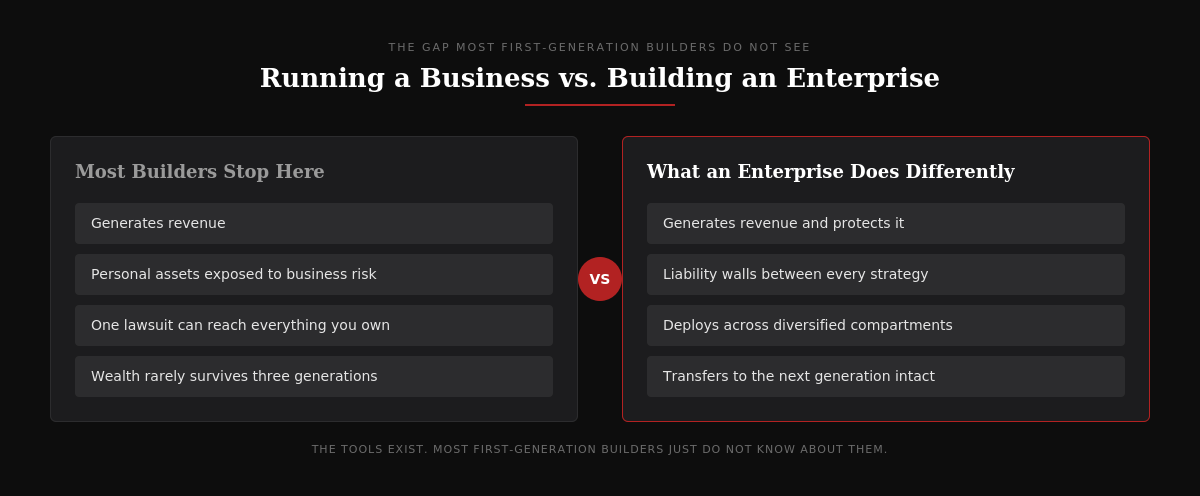
There is a difference between running businesses and building an enterprise, and most first-generation entrepreneurs never make the leap from one to the other. A business generates revenue. That is valuable. But a business on its own is exposed. If the owner gets sued, the business is at risk. If the business gets sued, the owner’s personal assets are at risk. If one venture fails, it can drag down every other venture the owner is involved in because there is nothing separating them. An enterprise does something fundamentally different. It generates revenue, protects it across multiple layers, deploys it across diversified strategies, and transfers it to the next generation without losing it along the way. That is what Nathan built.
The decision to build institutionally rather than just operationally came from watching what happens when you do not have structure. It came from nine years in the hospitality industry, where Nathan learned the waterfall payback strategy, the discipline of maintaining separate financial records for every entity, and the patience required to build a portfolio of appreciating assets using other people’s capital while waiting years to see his own returns. It came from the capital markets, where he sat in rooms with established families and watched how they organize their wealth, how they separate their risk, and how they make decisions with a time horizon measured in decades rather than quarters. Those families had infrastructure that Nathan did not grow up with. But the tools they used were not locked behind a gate. They were available to anyone who knew they existed and was willing to learn how they worked.
So Nathan learned. And then he built.
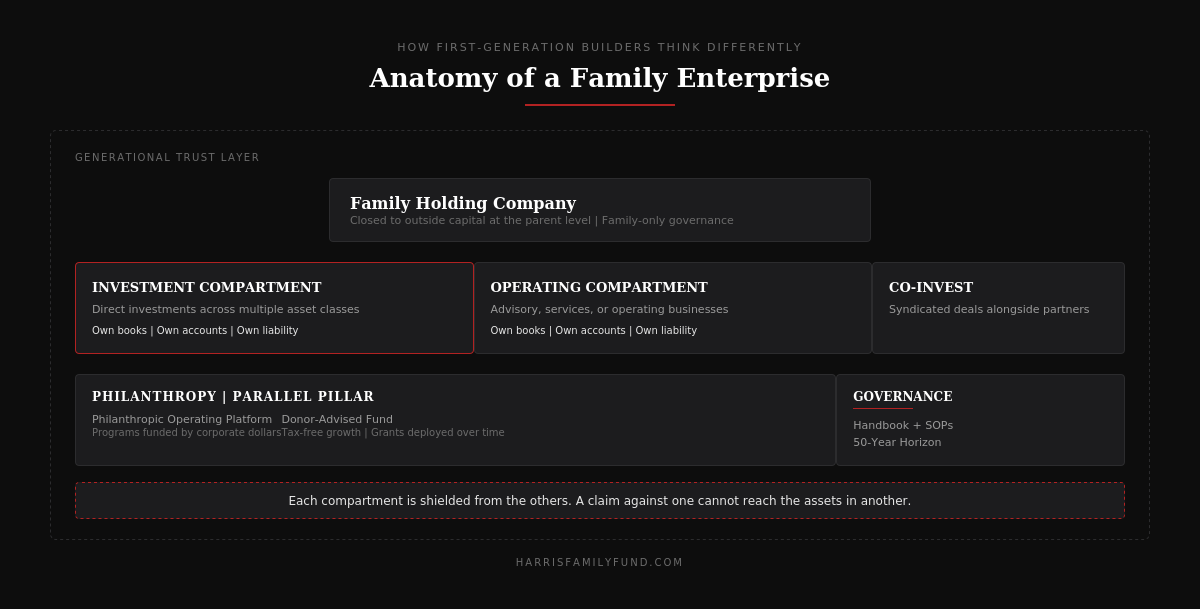
The Harris Family Fund is organized as a family enterprise with separate protected compartments. Each compartment holds its own assets, maintains its own financial records, its own bank accounts, and carries its own liability. If one area of the enterprise faces a challenge, the others are shielded. The walls between them are not theoretical. They are structural, maintained through operational discipline and documented in the governing agreements. Adding a new compartment as the family’s interests grow does not require building a new entity from the ground up. It is an internal expansion of the existing architecture. The structure scales as the family grows.
Inside the fund, the family operates across three lanes. Each one serves a different purpose and carries a different risk profile, which is exactly why they are separated.
The first lane is direct investment through Harris Family Circle. This is the family’s private equity arm, and it is where Nathan deploys capital across real estate, hospitality, technology, and diversified opportunities that align with the family’s long-term goals. Nathan serves as General Partner of Harris Family Circle. His background includes hospitality and commercial real estate at significant scale across multiple venues, and that operational experience informs every investment decision. The philosophy is long-term hold with operational involvement where appropriate. Unlike the parent fund, Harris Family Circle is structured to allow outside investors to invest alongside the family, creating a vehicle where trusted partners can participate in opportunities that Nathan sources and underwrites while the family maintains control of the decision-making.
The second lane is innovation and advisory through Immersion Inno. This is the firm Nathan runs as Partner alongside Kiam Donte Cook, an Army veteran who also leads the family’s philanthropic operations. It is a true 50/50 partnership. Immersion operates across 14 defined service lines spanning innovation delivery, capital advisory, consortium development, fractional executive services, and philanthropic program management. Its primary value comes from equity positions and long-term profit sharing, not hourly billing. That distinction matters. Immersion is not a consulting firm that trades time for money. It is an advisory firm that builds long-term alignment with the organizations it serves. It also functions as a deal-flow engine for the rest of the enterprise. The advisory relationships generate proprietary access to investment opportunities that would not surface through traditional channels, and those opportunities feed back into Harris Family Circle and the syndication vehicle.
The third lane handles co-investments and syndicated opportunities alongside other families, funds, and institutional partners. When the advisory work or the family’s network surfaces deals that exceed the private equity arm’s allocation capacity or fall outside its core strategy, they flow through this vehicle. It allows the family to participate in opportunities alongside trusted co-investors while maintaining the liability separation that protects the rest of the enterprise.
The question Nathan gets asked most often about this structure is why it is closed at the parent level. The answer is straightforward. Outside capital at the holding company level introduces outside governance expectations. It introduces external reporting obligations. And most importantly, it introduces the pressure to optimize for quarterly returns rather than generational outcomes. Nathan built this fund with a 50-year horizon. That kind of patience requires a kind of freedom that is incompatible with the expectations that come from third-party investors sitting at the top of the structure.
This does not mean the Harris family enterprise operates in isolation. The opposite is true. Immersion’s advisory relationships connect the family to a broad ecosystem of family offices, institutional investors, corporate innovation teams, universities, healthcare systems, and founders. Harris Family Circle provides a vehicle for outside investors to deploy capital alongside the family in specific opportunities. The consortium creates structured community around shared interests and shared deal flow. The enterprise is closed for protection at the top. It is open for collaboration everywhere else. The architecture is designed so that the family never has to choose between protecting what they have built and engaging with the world around them.
The philanthropic arm of the enterprise deserves its own chapter, and it has one elsewhere on this site. But it matters here because it is not an add-on. The philanthropy is a co-equal pillar of the Harris Family Fund, not a line item that gets funded after the investment returns come in. iiCare, the family’s philanthropic operating platform, and the Harris Family Impact Fund, a donor-advised fund that compounds giving capacity over time, operate with the same institutional discipline as the investment portfolio. They exist because Nathan built this enterprise to serve communities, not just to accumulate returns. The mission is structural, not seasonal.
A dynasty trust wraps the entire architecture. A governance handbook documents every structure, every decision framework, and every succession pathway so that future Harris family members can understand how and why the family operates the way it does. Nathan did not write a governance handbook because a lawyer told him to. He wrote it because he grew up in a family where the love was always there but the communication was not, and he is determined that the next generation will never have to guess how things work or why decisions were made.
Every decision in this enterprise is measured against a 50-year horizon. Not a quarterly one. Not an annual one. Fifty years. That means every investment, every partnership, every structural choice is evaluated by a simple question: does this still make sense when Nathan’s grandchildren are running it? If the answer is no, it does not get built. If the answer is yes, it gets built to last.
Nathan Harris did not build the Harris Family Fund because he read a book about family offices and decided it sounded sophisticated. He built it because he spent twenty years learning what happens when talented people build valuable things without protecting them. He lost years of his life to a handshake agreement that was never signed. He watched operators around him lose everything because nobody taught them that the tools to prevent it existed. And he decided that his family, and the families connected to his ecosystem, would never face that same vulnerability if he could help it.
The Harris Family Fund is a closed family enterprise built by a first-generation entrepreneur who had no blueprint, no inheritance, and no safety net. It exists to prove that institutional infrastructure is not reserved for the families who have always had it. It is available to anyone willing to learn how it works and disciplined enough to maintain it. Nathan is building the proof point. The system can work differently if you build it differently. And the Harris Family Fund is the system.
This is the second chapter in the Harris Family Fund story. To understand the full origin story, read the previous chapter: 20 Years: The Full Story of Nathan Harris. To understand the philanthropic pillar that runs alongside the investment portfolio, read The Real Reason Behind Everything We Built.