
The Real Reason Behind Everything We Built
Most people who build wealth eventually write a check to a cause they care about. They attend a gala. They sponsor a table. They put their name on a program. And then they move on to the next quarter, the next deal, the next return. There is nothing wrong with that. But it is not what Nathan Harris built. What he built is something structurally different, and the difference matters more than most people realize.
The philanthropic mission inside the Harris Family Fund is not a department. It is not a line item that gets funded after the investment returns come in. It is a co-equal pillar of the entire enterprise, built with the same institutional discipline, the same governance rigor, and the same generational time horizon as the investment portfolio. Nathan did not add philanthropy to his family enterprise because it looked good on a website. He built it because he lived through the thing that philanthropy is supposed to address, and he knows exactly what it feels like when the system does not show up for you.
When Nathan was twelve years old, his family needed help. Not the kind of help that comes from a viral campaign or a celebrity endorsement. The kind of help that is so small it barely registers as charity to the person giving it. Fifty dollars so two boys could eat. A grandfather who gave them work. A neighbor who did not ask questions. Those moments, those micro-interventions, were the difference between the Harris family making it and not making it. Nathan has never forgotten that. And every philanthropic structure he has built since carries the same principle at its center: small, intentional acts of support, delivered to the right people at the right time, can change the entire trajectory of a family.
But Nathan also learned something else along the way. He learned that good intentions without good structure produce the same result as no intentions at all. He watched well-meaning organizations burn through donated dollars on overhead and administrative costs. He watched campaigns that generated massive awareness and almost no lasting impact. He watched the philanthropic world operate with a fraction of the discipline that the investment world demands, and he saw the consequences of that gap in every community he touched.
So when he built the philanthropic arm of the Harris Family Fund, he did not build a charity. He built infrastructure.
There is a fundamental difference between writing a check and building a system that compounds your ability to give over time. Most people experience philanthropy as a one-time transaction. You earn money, you give some of it away, and the money is gone. If you want to give again next year, you have to earn more. Your giving capacity is directly tied to your income in any given year, which means your philanthropy is as volatile as your revenue. If you have a bad year, your giving declines. If you have a great year, you might give more, but there is no mechanism to capture that momentum and let it build.
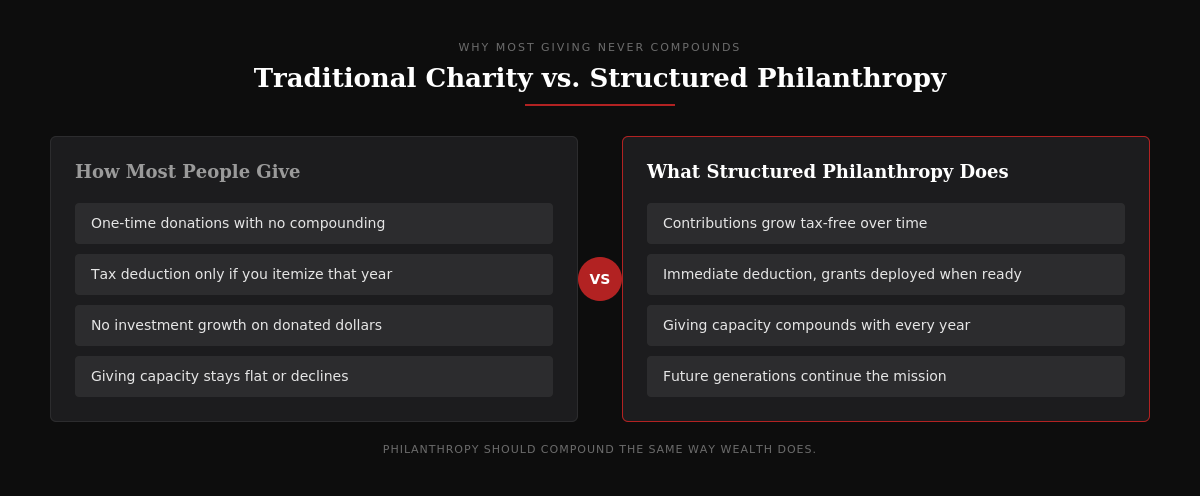
Structured philanthropy works on a completely different model. Instead of giving dollars directly to a cause and watching them leave your balance sheet permanently, you contribute assets into a giving vehicle that holds, invests, and grows those assets tax-free. You receive the tax benefit immediately at the time of contribution. But you do not have to recommend grants right away. The assets sit inside the vehicle, invested and compounding, until you are ready to deploy them. When you do recommend a grant, the dollars go to qualified programs on your timeline, not on the timeline of whoever is asking for money. The tax event and the giving event are completely decoupled. Both work harder because of it.
That is how a donor-advised fund works. And it is the engine behind the Harris family’s long-term philanthropic strategy.

The question Nathan kept asking himself as he designed this structure was simple. Why should philanthropy be the one part of a family enterprise that does not compound? Every other piece of the architecture is designed to grow over time. Investments appreciate. Advisory relationships deepen and produce more deal flow with each passing year. The trust structure shields wealth across generations so it can continue building. But in most family enterprises, philanthropy is treated as a static expense rather than a dynamic system. Nathan rejected that framing entirely. He built the philanthropic infrastructure to compound the same way everything else in the enterprise compounds.
That decision is what led the Harris family to develop what Nathan calls catalytic capital. The term describes patient, risk-tolerant, flexible funding that is designed to unlock outcomes across a range of industries and communities simultaneously. It is the opposite of extractive capital, which enters a system, takes its return, and leaves. Catalytic capital enters a system, creates conditions for growth, and stays long enough for the impact to take root.
The way the Harris family deploys catalytic capital through its philanthropic arm is different from anything most people have encountered. The family identified that the same barriers Nathan experienced growing up, barriers to healthcare access, economic mobility, workforce development, and community infrastructure, are not isolated problems. They are interconnected systems that fail together and succeed together. A family that cannot access quality healthcare cannot maintain stable employment. A community without workforce infrastructure cannot attract the kind of investment that creates healthcare access. The cycle reinforces itself in both directions. Breaking it requires capital that is willing to touch multiple points in the system at the same time, with the patience to wait for compounding results rather than quarterly returns.
That insight shaped every aspect of the philanthropic model. Instead of funding one cause in one vertical, the Harris family built a philanthropic platform that can deploy resources across healthcare, workforce development, economic mobility, and community empowerment simultaneously. The programs are designed to reinforce each other. A healthcare initiative in a community creates stability. That stability makes workforce programs more effective. Effective workforce programs attract economic investment. Economic investment funds the next cycle of healthcare and community programming. Each grant the family recommends from the donor-advised fund is not a standalone gift. It is a strategic deployment into an interconnected system designed to produce compounding returns measured in human outcomes rather than financial ones.
The operational side of the family’s philanthropy runs through a platform that works under fiscal sponsorship from an established organization with significant capacity and infrastructure. That arrangement is intentional. It means the family’s philanthropic programs can receive donations, issue grants, and run initiatives without the overhead and regulatory burden of forming a standalone nonprofit entity. The compliance, the audits, the fiduciary requirements are all handled by the sponsoring organization. The family focuses on what it does best: identifying needs, designing programs, and deploying resources where they will have the most impact.
One of the things Nathan is most deliberate about in the way the family talks about its philanthropy is the source of the funding. The philanthropic model is funded by corporate dollars, not fan donations. That distinction is critical and it is maintained in every public-facing communication. The programs are not built on the backs of individual donors giving $5 or $10. They are funded by corporate partnerships, institutional commitments, and the family’s own contributions through the donor-advised fund. That funding model is more stable, more scalable, and more aligned with the kind of long-term community work the family is committed to.
The family has built partnerships with some of the most recognizable figures in professional sports and entertainment for its philanthropic campaigns. These are not endorsement deals. They are results-based activations where athletes, entertainers, and cultural leaders lend their platforms to campaigns that are measured by outcomes, not impressions. The campaigns generate real revenue, real donor engagement, and real community impact, and the results are shared publicly because accountability is part of the model. Specific dollar allocations from internal fund documents are not shared publicly. But campaign performance is, because the people who support this work deserve to know that it is working.
Nathan also built something into the philanthropic infrastructure that most people in the giving world have never seen. It is a financial architecture that integrates live and on-demand programming with real-time donations and matched investment capital. The model pairs donated dollars with venture capital through a structured matching mechanism, so every dollar given is amplified by investment capital up to an annual cap. Content funds campaigns. Campaigns fund content. Both fund the mission. The unit economics have been proven through real campaigns with real results, and the model is intentionally open in its philosophy. Nathan does not protect this framework behind patents or proprietary walls. He wants it adopted widely because the more organizations that use it, the more communities benefit. Widespread adoption is the goal, not competitive advantage.
That decision, to make the philanthropic infrastructure open rather than proprietary, tells you everything you need to know about why this pillar exists. Nathan did not build it to create a moat. He built it to solve a problem. And the problem does not get solved if the solution sits in one family’s portfolio. It gets solved when the model proves itself and other families, other funds, and other organizations start building the same way.
The connection between the investment side and the philanthropic side of the Harris Family Fund is structural, not cosmetic. The donor-advised fund receives contributions during high-income years when the tax benefit is most valuable. Those contributions grow tax-free inside the fund, increasing the family’s giving capacity over time. When the family is ready to deploy resources, they recommend grants from the fund to the philanthropic operating platform, which then executes the programs. The cycle is continuous. Earn, contribute, grow, grant, deploy, measure, repeat. Each rotation makes the next one more powerful.
This is not how most families approach philanthropy. Most families treat giving as an expense. Nathan treats it as an investment in infrastructure that compounds. The difference is not philosophical. It is mathematical. A donor-advised fund that receives consistent contributions and grows at market rates will have dramatically more giving capacity in twenty years than the same family writing checks directly to causes each year. The family that builds the structure gives more over time, not less. And they do it with more precision, more accountability, and more continuity across generations.
The catalytic capital model the Harris family developed has implications that extend far beyond their own portfolio. It provides a framework for how any family, any fund, or any institution can structure its giving to produce compounding impact rather than one-time relief. The traditional philanthropic model asks: how much can we give this year? The catalytic capital model asks: how do we build a system that gives more every year, indefinitely, across the industries and communities that need it most? That is a fundamentally different question, and it produces fundamentally different results.
The reason Nathan elevated philanthropy to a co-equal pillar of the Harris Family Fund, rather than treating it as a supporting function, is personal. He grew up in a family where the difference between making it and not making it came down to the smallest possible acts of generosity from people who had almost nothing to give. He knows what it feels like to need help and not know where to find it. He knows what it feels like when the system is not designed for you. And he decided, long before the Harris Family Fund existed as a legal entity, that any enterprise he built would be structurally committed to serving the communities that the traditional systems leave behind.
The philanthropy is not separate from the investment portfolio. It runs parallel to it. They share the same governance structure, the same operational discipline, and the same 50-year time horizon. When Nathan’s grandchildren sit down to review the family enterprise, they will see two pillars standing at equal height: one that builds wealth and one that gives it back. That is not an accident. That is the design.
Nathan Harris did not build a philanthropic platform because it was expected. He built it because he made a promise to himself when he was twelve years old, sitting in a house with no electricity, checking whether his mother was still breathing, that if he ever had the ability to build something that could help families like his, he would. The Harris Family Fund is how he keeps that promise. The investment side builds the resources. The philanthropic side deploys them. And the structure ensures that the mission does not end when Nathan’s chapter does.
Not allowing these things to break our souls is what really mattered. That line belongs to Nathan’s mother. It is the reason the philanthropy exists. And it is the reason it will never be an afterthought.
This is the third chapter in the Harris Family Fund story. To understand the full origin, read the first chapter: 20 Years: The Full Story of Nathan Harris. To understand the system that makes this possible, read the second chapter: What Is the Harris Family Fund and Why Does It Exist. The next chapter explains how protected structures work and why more builders should know about them: How Series-Based Structures Work and Why More Builders Should Know.